

Introduction
In today’s cloud-driven enterprise world, seamless integration and data flow are the foundation of digital transformation. Oracle offers multiple integration services, each designed for specific use cases. Two of the most powerful are Oracle Integration Cloud (OIC) and OCI Data Integration (OCI DI) but when should you use one over the other?
_______________________________________________________________________________________________________________
Oracle Integration Cloud (OIC)
-
Purpose: Real-time application integration and workflow automation.
-
Use Case: Connects Oracle SaaS apps (ERP, HCM, CX) and third-party systems.
-
Key Components: Integrations, Process Automation, Visual Builder, API Gateway, and B2B.
OCI Data Integration (DI)
-
Purpose: Data movement, transformation, and analytics preparation.
-
Use Case: Extract, Transform, and Load (ETL/ELT) data into data lakes or warehouses.
-
Key Components: Data Flows, Mappings, Data Lineage, and tight OCI service integration.
_______________________________________________________________________________________________________________
Use OIC when:
-
Integrating SaaS or On-Premise Apps
Easily connect Oracle ERP, HCM, CX, Salesforce, or Workday through 70+ prebuilt adapters. -
Real-Time Data Flows
Trigger integrations instantly e.g., when an invoice is approved in ERP, notify HCM. -
Business Process Orchestration
Design and execute workflows with human tasks, approvals, and conditional logic. -
API Management
Expose, manage, and monitor REST/SOAP APIs within a unified platform. -
Human Approvals
Include manual review and escalation processes in automated workflows. -
B2B Integration
Built-in support for protocols like EDI, AS2, and RosettaNet.
✅ Best for: Application-to-Application Integrations, Process Automation, API Orchestration, B2B, and Event-Driven Architectures.
_______________________________________________________________________________________________________________
Use OCI DI when:
-
Building ETL/ELT Pipelines
Ingest, cleanse, and load data into data lakes, ADW, or analytics platforms. -
Data Lakehouse Architecture
Create pipelines for machine learning or BI dashboards. -
Complex Data Transformations
Visually map and transform schemas with built-in lineage tracking. -
High-Volume Data Movement
Ideal for bulk loads and scheduled jobs. -
Low-Code Data Engineering
Build pipelines visually no need to write extensive code. -
Cost-Effective for Batch Jobs
Pay only for data pipeline runs, not for always-on compute.
_______________________________________________________________________________________________________________
✅ Best for: Batch Data Processing, Data Lakes, Analytics, ETL/ELT, and Integration with OCI data stack.
| Decision Criteria | Oracle Integration Cloud (OIC) | OCI Data Integration (DI) |
|---|---|---|
| Primary Focus | Real-time application and process integration | Batch-driven data integration (ETL/ELT) |
| Integration Type | Application-to-Application (A2A), API-based | Data-to-Data, analytics-driven |
| Real-Time Integration | ✅ Fully supported with event triggers | ❌ Not supported (batch only) |
| Batch Processing (ETL/ELT) | 🟡 Limited via data adapters | ✅ Fully supported |
| SaaS Connectivity | ✅ 70+ Oracle & non-Oracle adapters | ❌ Limited data source support |
| On-Premise Connectivity | ✅ Through OIC Connectivity Agent | 🟡 Limited via network setup |
| API Management | ✅ Built-in API gateway and REST/SOAP support | ❌ Not available |
| Workflow Automation (BPMN) | ✅ Supports human tasks and approvals | ❌ Not available |
| Event-Driven Architecture | ✅ Full event, trigger, and webhook support | 🟡 Micro-batch limited |
| Data Transformation | 🟡 Light mapping and scripts | ✅ SQL-based complex transformations |
| Data Lake & Warehouse Integration | 🟡 Limited | ✅ Deep integration with ADW, Object Storage |
| B2B / EDI Support | ✅ Native AS2, EDI, and RosettaNet | ❌ Not supported |
| Monitoring & Logging | ✅ Advanced dashboards and integration insights | 🟡 Basic job-level monitoring |
| Cost Model | Based on message volume and runtime | Pay-per-pipeline execution (serverless) |
| Skillset Required | Integration Developer / Functional Consultant | Data Engineer / ETL Developer |
| Use with OCI Services | 🟡 Via adapters | ✅ Deep native integration |
| Best For | SaaS integration, workflows, APIs, hybrid orchestration | Data movement, ETL/ELT, analytics, ML pipelines |
| Example Use Case | Sync invoice from ERP to HCM and notify approvers | Load financial data from ERP to ADW nightly |
______________________________________________________________________________________________
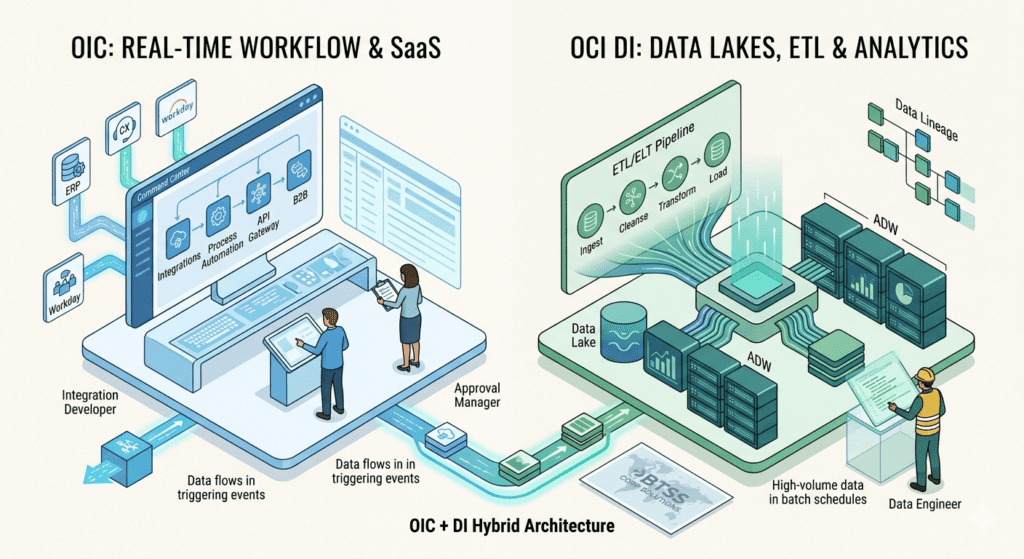
Combining OIC + DI
In many enterprise setups, consultants design hybrid architectures leveraging both platforms:
Example Use Case:
-
Data Integration: OCI DI loads data from ERP and CRM into ADW.
-
Process Automation: OIC triggers workflows once data pipelines complete.
-
Notification & Reporting: OIC sends emails or updates dashboards in real-time.
It merges OIC’s orchestration and API strengths with DI’s scalable data transformation capabilities, providing a unified data-to-process automation flow.
_______________________________________________________________________________________________________________
Partner Perspective – BTSS Consulting
At BTSS, our Oracle consultants specialize in integration architecture, OIC implementation, and OCI data engineering.
We help clients build connected, intelligent, and automated systems that simplify business operations, enhance analytics, and reduce integration costs.
If you’re exploring Oracle Integration Cloud or OCI Data Integration, our experts can guide you through setup, best practices, and optimization strategies for your enterprise.
